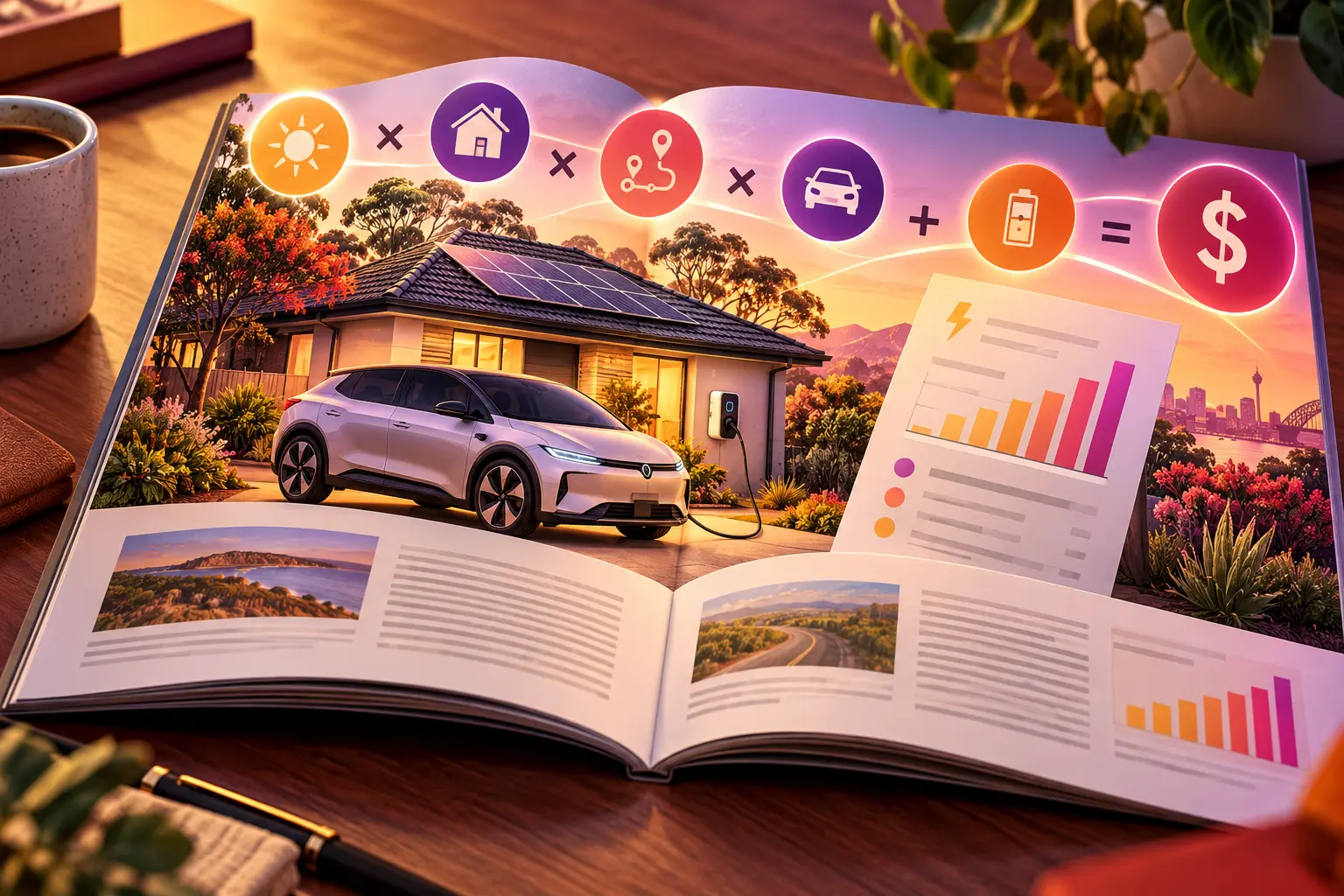
For many Australian drivers, charging an electric vehicle at home is substantially cheaper than relying on public fast charging. But there is no single correct national figure. Your real cost depends on how far you drive, your EV’s energy consumption, your electricity tariff and the energy lost while charging.
For a worked example—15,000 kilometres a year, energy consumption of 17 kWh/100 km, 10% charging loss and electricity at 30 cents per kWh—the estimated home-charging cost is about $850 per year, or 7.1 cents per kilometre.
Change the tariff to 15 cents per kWh and the same vehicle costs about $425 per year to charge. At 40 cents per kWh, it rises to about $1,133 per year. Timing your charging can therefore matter almost as much as choosing an efficient vehicle.
Calculate your own cost
Use your electricity bill and vehicle figures for a decision-quality result.
Open the free calculatorThe quick calculation
Annual battery energy (kWh) = annual kilometres × EV consumption ÷ 100
Then allow for charging loss:
Electricity drawn from the home (kWh) = battery energy ÷ charging efficiency
Finally:
Annual charging cost = electricity drawn × electricity price per kWh
Worked example
- Annual driving: 15,000 km
- EV efficiency: 17 kWh/100 km
- Charging loss: 10%, equivalent to 90% charging efficiency
- Electricity tariff: $0.30/kWh
15,000 × 17 ÷ 100 = 2,550 kWhdelivered to the battery2,550 ÷ 0.90 = 2,833 kWhdrawn from the home2,833 × $0.30 = approximately $850 per year
That equals about $71 per month, $16 per week, or 7.1 cents per kilometre. These are calculated examples, not advertised market averages.
Estimated cost at different electricity rates
This comparison keeps the same annual distance, vehicle efficiency and charging loss, while changing only the electricity tariff.
| Electricity rate | Annual cost | Monthly cost | Cost per km |
|---|---|---|---|
| 10 c/kWh | $283 | $24 | 2.4 c |
| 15 c/kWh | $425 | $35 | 3.5 c |
| 20 c/kWh | $567 | $47 | 4.7 c |
| 30 c/kWh | $850 | $71 | 7.1 c |
| 40 c/kWh | $1,133 | $94 | 9.4 c |
The rate paid while the car is charging is a major cost lever. Australian Government guidance notes that time-of-use plans can provide cheaper off-peak rates, while NSW guidance recommends charging during cheaper periods or when surplus rooftop solar is available.
How much does one full charge cost?
Battery capacity is useful for estimating the price of a full charge, but it does not determine annual cost. Annual distance and efficiency do.
For a 60 kWh battery, 10% charging loss and electricity at 30 cents per kWh: 60 ÷ 0.90 × $0.30 = approximately $20. At 15 cents per kWh, the same theoretical 0–100% charge costs about $10. In practice, most owners charge in smaller top-ups.
What changes your actual home-charging cost?
1. Your electricity plan
A flat tariff applies the same usage rate throughout the day. A time-of-use plan charges different rates during peak, shoulder and off-peak periods. An EV adds a large, flexible load, so scheduling outside peak periods can materially reduce cost.
Compare the whole plan: usage rates, daily supply charge, tariff hours, EV-specific conditions, solar feed-in tariff and the expiry of discounts. The Australian Energy Regulator requires participating retailers to show a “Could you save money on another plan?” message on the first page of electricity bills.
2. Vehicle energy consumption
EV consumption is normally expressed in kWh/100 km. A lower number means the vehicle needs less electricity for the same distance. Real consumption can change with speed, weather, hills, loads, roof racks, towing, tyre pressure and acceleration. Use the vehicle’s long-term real consumption when available.
3. Charging losses
Not every kilowatt-hour drawn from the home reaches the battery. Some energy is used by charging electronics, battery temperature management and other vehicle systems. Loss varies with the vehicle, charger, power level, temperature and battery state. Update your estimate when your charger or vehicle app provides measured figures.
4. Rooftop solar
Charging from surplus daytime solar can reduce the cash paid to a retailer. However, solar electricity is not always economically free. If it would otherwise have been exported, its opportunity cost is the feed-in tariff forgone.
Using 10 kWh of surplus solar that could have earned a 5 c/kWh feed-in tariff has an opportunity cost of about 50 cents. Buying the same energy from the grid at 30 c/kWh would cost $3.00. Solar charging still has a clear advantage in this simplified example.
5. How far you drive
Double the annual distance and, with the other inputs unchanged, the charging cost approximately doubles. A low-kilometre household should not assess a charger investment using savings claimed by a high-kilometre fleet.
Do you need a dedicated home charger?
Not always. Some owners can recover their normal daily driving using a suitable household power point. Others need the additional speed, scheduling, monitoring and safety features of a dedicated wall charger.
NSW Government guidance describes household power-point charging as a slower Level 1 option and a dedicated wall unit as Level 2. It advises using compliant equipment and a licensed electrician for a wallbox installation. Its consumer guidance gives a broad installed-cost range of $200 to $5,000+, reflecting major differences in equipment and site works.
Before buying, consider daily kilometres, parking time, electrical supply, switchboard capacity, cable route, solar integration, load management, strata approval and scheduling capability. Obtain site-specific quotations from licensed electricians experienced in EV charging.
Five ways to reduce EV charging costs
- Use your real tariff. Take the cents-per-kWh rate from your current plan.
- Schedule carefully. Move flexible charging away from peak periods when your tariff rewards it.
- Use genuine solar surplus. Charge when rooftop generation exceeds household demand.
- Review the whole plan. A cheap overnight rate can be offset by expensive peak usage or a higher supply charge.
- Track actual consumption. Compare charger energy with kilometres driven, then update the estimate.
Home charging versus public fast charging
Home charging is normally the foundation for routine use when off-street parking is available. Public charging provides coverage for road trips, drivers without suitable home parking and rapid top-ups. A fair annual budget estimates the energy obtained at home, work and paid public chargers, then applies the relevant rate to each share.
Frequently asked questions
Is it cheaper to charge an EV at night?
It can be, but only if your electricity plan has a cheaper off-peak or EV charging period. A flat-rate plan may charge the same usage rate at all times. Check the tariff and time windows in your plan before scheduling the vehicle.
Can I charge an EV from rooftop solar?
Yes. Charging during periods of surplus solar can reduce grid purchases. Your result depends on system size, household load, weather, vehicle availability and charger controls. Also consider the feed-in tariff forgone when solar energy is redirected from export to the car.
Does a larger battery always cost more each year?
No. Battery size determines how much energy a full charge can hold, not how much you drive annually. Annual cost is driven primarily by kilometres travelled, vehicle efficiency, charging loss and electricity price.
How can I find my EV energy-consumption figure?
Check the vehicle specification, energy label or long-term consumption display in the vehicle. Real consumption from your normal driving is generally more representative than a laboratory rating alone.
Should I include the daily electricity supply charge?
For the marginal cost of charging an EV, households usually exclude a supply charge they would pay even without the vehicle. Include any additional fixed charge created by moving plans, adding a separate meter or using a charging service.
Calculate your own result
Test your annual distance, vehicle efficiency, charging loss and actual electricity rate.
Calculate home charging costEditorial sources
- NSW Climate and Energy Action — Install a home electric vehicle charger
- Australian Government — Smart homes
- Australian Energy Regulator — Better Bills Guideline
- NSW Climate and Energy Action — Buying an electric vehicle